Namdaemun Market (남대문시장)
13.4Km 2024-05-17
21, Namdaemunsijang 4-gil, Jung-gu, Seoul
+82-2-753-2805
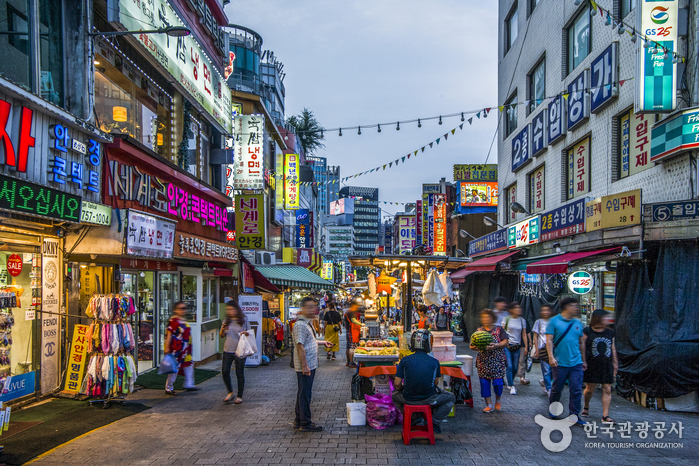
Opened in 1964, Namdaemun Market is the largest traditional market in Korea with shops selling various goods. All products are sold at affordable prices and the stores in this area also function as wholesale markets.
Most of the goods are made directly by the storeowners. Namdaemun Market is even open overnight, from 23:00 to 04:00, and is crowded with retailers from all over the country. When day breaks, the site of busy shoppers bustling around the market creates a unique scene that attracts tourists worldwide. Namdaemun Market sells a variety of clothes, glasses, kitchenware, toys, mountain gear, fishing equipment, stationery, fine arts, accessories, hats, carpets, flowers, ginseng, and imported goods.
![Namyangju Sareung Royal Tomb [UNESCO World Heritage] (남양주 사릉(정순왕후) [유네스코 세계문화유산])](http://tong.visitkorea.or.kr/cms/resource/44/2480844_image2_1.jpg)
Namyangju Sareung Royal Tomb [UNESCO World Heritage] (남양주 사릉(정순왕후) [유네스코 세계문화유산])
13.4Km 2023-06-22
180, Sareung-ro, Namyangju-si, Gyeonggi-do
+82-31-573-8124
Sareung Royal Tomb is the tomb of Queen Jeongsun (1440-1521), a consort to King Danjong. She was perhaps the most tragic royal woman of the Joseon dynasty.
In 1453, she was selected to be queen out of many candidates and actually became the queen two years later. However, when King Danjong was forced to abdicate from the throne in 1457 and was exiled to Yeongwol in Gangwon-do, Queen Jeongsun was deprived of her title as well.
After King Danjong died, she built a thatched-roof house outside Seoul’s Dongdaemun Gate and lived there for the rest of her life, continuing to mourn her husband. The tomb’s name, Sareung, came from the fact that she had missed her dead husband so much.
Unlike other royal tombs, Sareung looks very simple. Its size is relatively small.
Bugeogukjip (북어국집)
13.4Km 2024-12-27
38, Eulji-ro 1-gil, Jung-gu, Seoul
+82-2-777-3891
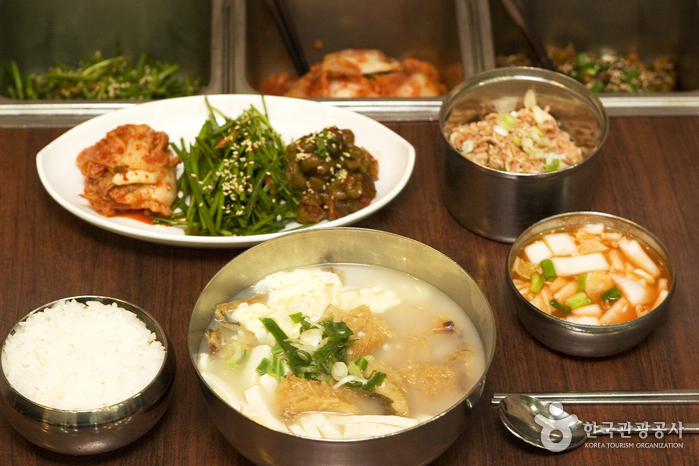
Bugeogukjip (formerly “Teojutgol”) is a restaurant behind City Hall in Seoul that has been serving up authentic dried Pollack soup since 1968. Despite a name change, the restaurant has proudly stood in this same location for decades, earning a strong reputation for its dried Pollack soup made using traditional cooking methods.
Since the restaurant only serves one thing—dried Pollack soup—there are few preparations to be made and the meal arrives on your table in minutes. Customers are free to serve themselves basic side dishes such as kimchi and can have as many servings of rice as they’d like, allowing diners to enjoy a hearty meal at a low price. While the restaurant’s design and menu may be simple, Bugeogukjip takes pride in its long history and the careful efforts that have earned it a reputation as one of the most notable restaurants in Seoul.
![Whixcom [Tax Refund Shop] (휙스컴)](http://tong.visitkorea.or.kr/cms/resource/83/2878583_image2_1.jpg)
![Go-un [Korea Quality] 고운 [한국관광 품질인증]](http://tong.visitkorea.or.kr/cms/resource/08/2948908_image2_1.JPG)
Go-un [Korea Quality] 고운 [한국관광 품질인증]
13.4Km 2024-08-14
35-1, Bukchon-ro 12-gil, Jongno-gu, Seoul
+82-504-0904-2464
Go-un, meaning "High Cloud," is a hanok stay atop a steep hill in Gahoe-dong, Bukchon Hanok Village, Jeongno-gu, Seoul. The view from the house’s big windows takes in hanok tiled roofs, Seoul’s downtown, and Inwangsan Mountain - a vista that merges the past and the present. After enjoying Bukchon's attractions, entertainment, and food, guests can relax in the hanok’s half-body bath overlooking the yard (mugwort bath salts provided) - or enjoy a movie on the beam projector.

Kim's Optical [Tax Refund Shop] (김안경)
13.4Km 2024-06-27
1F, D-10, 9, Namdaemunsijang 4-gil, Jung-gu, Seoul
-
India Art [Tax Refund Shop] (인도예술)
13.4Km 2024-06-26
1F, D-61, 9, Namdaemunsijang 4-gil, Jung-gu, Seoul
-
Taesan Total Kitchen [Tax Refund Shop] (태산종합주방)
13.4Km 2024-06-27
3F, D-35, 9, Namdaemunsijang 4-gil, Jung-gu, Seoul
-
![Kim's Optical [Tax Refund Shop] (김안경)](http://tong.visitkorea.or.kr/cms/resource/44/3313944_image2_1.jpg)
Jogyesa Temple (조계사(서울))
13.4Km 2024-10-25
55 Ujeongguk-ro, Jongno-gu, Seoul
As the main temple as well as the district head temple of the Jogye order in Seoul, Jogyesa Temple is the center of Korean Buddhism. The temple was built in the late 14th century during the Goryeo period but was completely destroyed in a fire. It was rebuilt under the name of Gakwangsa Temple in 1910 with the effort of many respectful monks, namely Han Yong-un and Lee Hee-gwang. The temple was given a role as the head temple of Korea’s Buddhism and renamed to Tegosa Temple in 1936. In 1954, a purification drive took place to eliminate Japanese influence and revive traditional Buddhism, which established the present day Jogyesa Temple as a result.
Jogyesa Temple plays an important role in Korean Buddhism as the head temple of the Jogye order. Jogyesa Temple’s Dharma Hall serves as the main venue for several Buddhist events, holding rituals, lectures, ceremonies, and other events all year long. The annual lantern festival in celebration of Buddha's birthday also takes place at this temple.
 English
 한국어
한국어 日本語
日本語 中文(简体)
 Deutsch
 Français
 Español
 Русский


