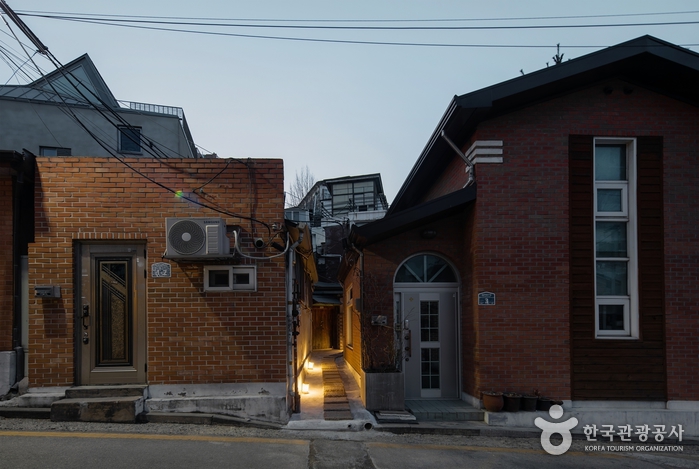
Nuwa (누와)
14.8Km 2024-12-23
3-1 , Pirundae-ro 5na-gil, Jongno-gu, Seoul
+82-504-0904-2313
Nuwa is a small, tastefully-renovated private hanok in the Seochon Village residential area to the west of Gyeongbokgung Palace in Seoul. It gets the light through a window wall in the living room, which contains a walnut table where guests can take tea, and a bathtub: weary travellers will feel better after taking a foot bath or half-body bath. High-quality tea and bath salts are provided. The sleeping space has an unusual round window, like a full moon, facing the bed, through which guests can see the top of Inwangsan Mountain as they fall asleep.
![HB Coms [Tax Refund Shop] (에이치비컴즈)](http://tong.visitkorea.or.kr/cms/resource/94/2891194_image2_1.jpg)
![Sjkcnc [Tax Refund Shop] (에스제이케이씨엔씨)](http://tong.visitkorea.or.kr/cms/resource/96/2891196_image2_1.jpg)
![Old and New [Tax Refund Shop] (올드앤뉴)](http://tong.visitkorea.or.kr/cms/resource/10/2891210_image2_1.jpg)
![Dongshin Electronics - Yongsan ETLand Branch [Tax Refund Shop] (동신전자 용산전자랜드)](http://tong.visitkorea.or.kr/cms/resource/03/2878503_image2_1.jpg)
Dongshin Electronics - Yongsan ETLand Branch [Tax Refund Shop] (동신전자 용산전자랜드)
14.8Km 2024-04-18
Store #B-11, #B-18, ET LAND Main Bldg. Plaza, 74, Cheongpa-ro, Yongsan-gu, Seoul
-
![TNT Info - Yongsan ETLand Branch [Tax Refund Shop] (티앤티정보 용산전자랜드)](http://tong.visitkorea.or.kr/cms/resource/86/2878486_image2_1.jpg)
TNT Info - Yongsan ETLand Branch [Tax Refund Shop] (티앤티정보 용산전자랜드)
14.8Km 2024-04-17
ET LAND (Main Bldg )3층A- 304.319, 74, Cheongpa-ro, Yongsan-gu, Seoul
-
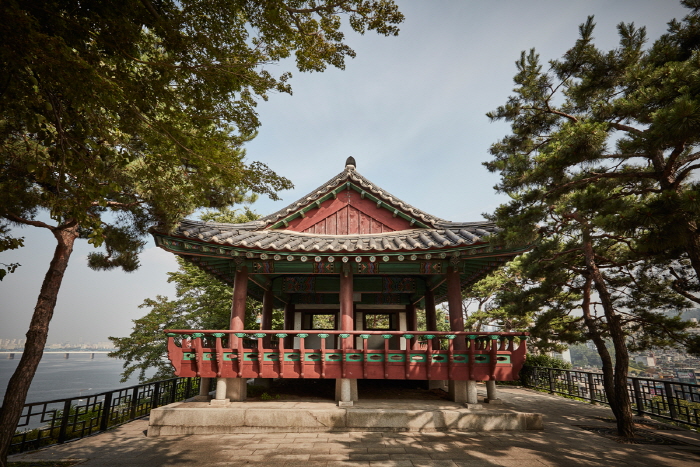
Hyosajeong Pavilion (효사정)
14.9Km 2025-01-13
55, Hyeonchung-ro, Dongjak-gu, Seoul
+82-2-820-9848
Hyosajeong Pavilion is where Nohan, the second vice premier of the Joseon dynasty during King Sejong and King Sejo’s reign, stayed. After he lost his mother, he built the pavilion to mourn at her grave while still being able to see his father’s grave in Gaeseong to the North. His brother-in-law, then Minister of the Interior, Gang Sa-deok named the pavilion “Hyosajeong,” which means pavilion of filial piety.
In order to find the original location of the pavilion, poems by Jeong Inji and Seo Geojeong and an old map of Korea were referenced, but the pavilion was not found because the surrounding landscape had changed too much. As a result, a location was selected and the pavilion was reconstructed at its current location. The house is 3 kan* in the front and 2 kan* on the side. The roof is a hip-and-gable roof. The pavilion has one room with under floor heating and a railing around the pavilion
(* kan: a traditional measurement that corresponds to the space between two columns)
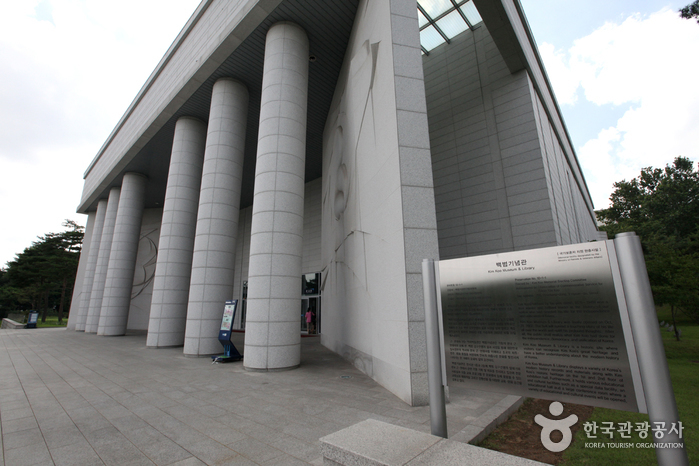
Kim Koo Museum & Library (백범김구기념관)
14.9Km 2022-08-30
26, Imjeong-ro, Yongsan-gu, Seoul
+82-2-799-3400
Kim Koo Museum & Library was built in Yongsan-gu, Seoul to commemorate Baekbeom Kim Koo (1876-1949), a highly respected Korean independence activist. It opened on October 22, 2002 to commemorate Kim Koo's efforts and achievements in Korean history. The main hall is comprised of two floors, exhibiting relics related to his entire life. A statue of a seated Kim Koo is situated in the central space of the first hall.

THE WELL SAEM HOSPITAL OF KOREAN MEDICINE (더웰샘한방병원)
14.9Km 2025-10-23
4th, 6th Floors, Hanil Plaza, 7 Namhyeon-gil (Namhyeon-dong), Gwanak-gu, Seoul
Integrative medicine, which links the strengths of Korea’s traditional medicine and Western medicine, is cutting-edge convergent medicine that provides optimal services for patients in most fields, except surgery and emergency medicine.
Traditional Korean treatments and modern medical treatments can deliver superior results compared to stand-alone therapies when applied in a patient-centered, multidisciplinary, and integrative manner. This is especially important for patients with intractable diseases such as cancer, severe chronic pain caused by aging and degenerative changes, and systemic symptoms resulting from recurrent inflammation and metabolic disorders. In such cases, integrative medicine represents a new paradigm that seeks not only physical health but also holistic recovery.
THE WELL SAEM HOSPITAL OF KOREAN MEDICINE pursues this integrative medicine, supporting patients’ faster recovery while also promoting the excellence of the Korean healthcare system worldwide, thereby aiming to create a pain-free, healthy world for all.
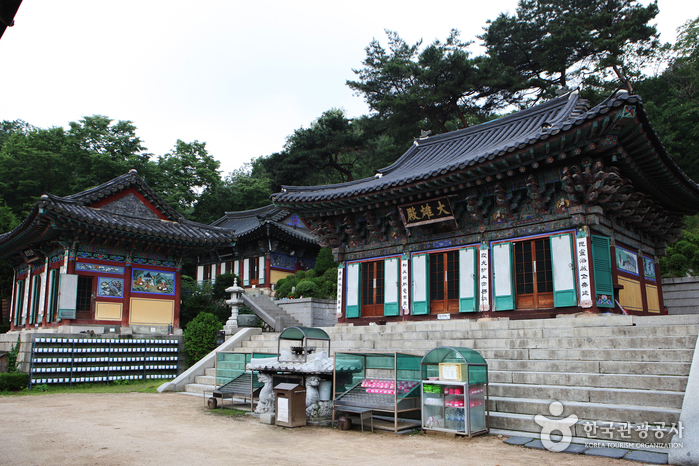
Seoul Hwagyesa Temple (화계사(서울))
14.9Km 2021-11-02
117, Hwagyesa-gil, Gangbuk-gu, Seoul
+82-2-902-2663
Hwagyesa Temple was built in 1522 (the seventeenth year of the reign of King Jungjong of the Joseon dynasty) by monk Shinwol, but was destroyed in a fire in 1618. It was rebuilt the following year, and expanded In 1866 through the efforts of Monks Yongseon and Beomun.
The temple also has various templestay programs for visitors. Hwagyesa Temple is located not too far from the city but also provides a natural environment.
 English
 한국어
한국어 日本語
日本語 中文(简体)
 Deutsch
 Français
 Español
 Русский


