April 19th National Cemetery (국립4.19민주묘지)
10.4Km 2023-01-02
17, 4.19-ro 8-gil, Gangbuk-gu, Seoul
+82-2-996-0419
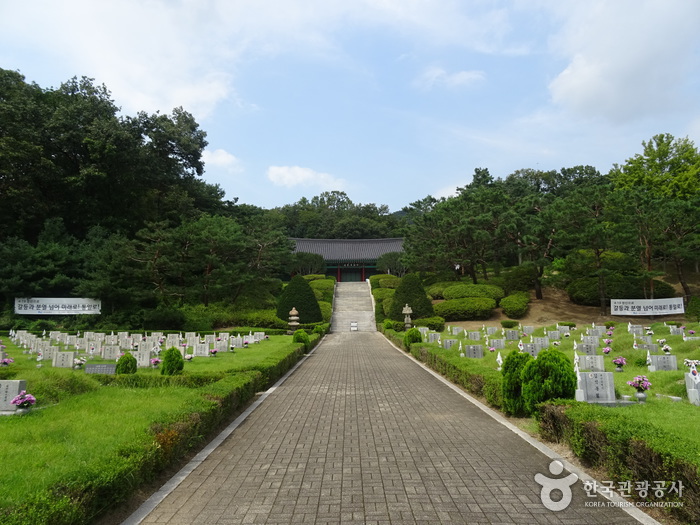
Located at the foot of Bukhansan Mountain, the April 19th National Cemetery was established in memory of the 224 people who lost their lives during the 4.19 Revolution in 1960. The cemetery features a memorial hall and a traditional wooden structure that houses the grave of the historic figure Yu Yeongbong.
At the cemetery is a pond surrounded by sculptures such as "Symbolic Door," "Roots of Democracy," and "Sparks of Justice" and a memorial tower bearing an inscription for the brave patriots who lost their lives during the revolution. Groves of pine, juniper, yew, and maple trees and the well-kept hiking path add a natural charm to the overwhelming ambiance of peace and serenity. Many people visit to see the spring blossoms in May, and throughout the year to take in the glorious scene of the sunset over Bukhansan Mountain.
Yeonghwiwon and Sunginwon Royal Tombs (서울 영휘원(순헌황귀비)과 숭인원(이진))
10.5Km 2021-03-12
90, Hongneung-ro, Dongdaemun-gu, Seoul
+82-2-962-0556
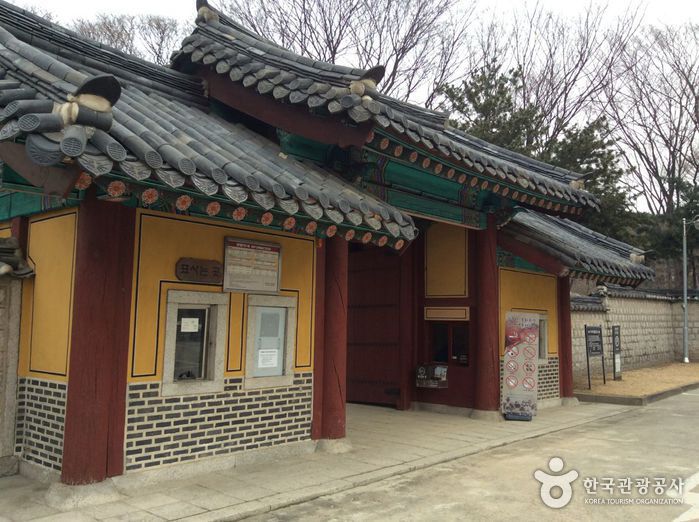
Yeonghwiwon & Sunginwon Royal Tombs house the tombs of Queen Consort Sunheon and the first son of Imperial Prince Yeong, Yi Jin. Queen Consort Sunheon was a concubine of Emperor Gojong and the mother of Imperial Prince Yeong. The tomb site was originally the resting place of Empress Myeongseong, the first official wife of Emperor Gojong, but her tomb was moved to Namyangju after Gojong's death where they are interred together.

Olive Young - Pyeongnaehopyeong Station Branch [Tax Refund Shop] (올리브영 평내호평역점)
10.5Km 2024-06-27
1F, 32, Neureul 2-ro, Namyangju-si, Gyeonggi-do
-
Dobongsan Mountain (도봉산)
10.6Km 2021-06-29
Dobong-dong, Dobong-gu, Seoul
+82-2-954-2566
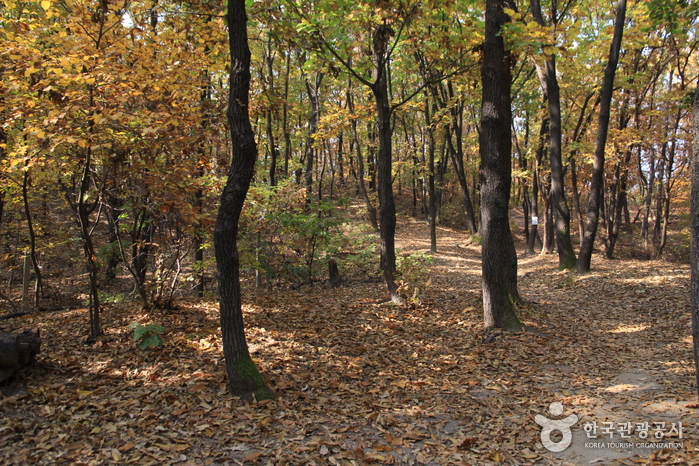
Dobongsan Mountain, located in the northeastern section of Bukhansan National Park, is known for the magnificent rock formations of the main peak, Jaunbong Peak (740.2 m), as well as Manjangbong, Seoninbong, Jubong, Obong Peaks and Uiam Rock. Seoninbong Peak in particular has 37 hiking courses, including the famous Bakjwi (Bat) Course.
The mountain is also home to Cheonchuksa Temple, the oldest temple in the region, and several other temples including Mangwolsa and Hoeryongsa Temples, as well as a number of beautiful valleys such as Dobonggyegok, Songchugyegok, Obonggyegok and Yeongeocheongyegok Valleys. Dobongsan Mountain is easily accessible by public transportation, making it a popular attraction for people living in Seoul.
Amsa-dong Prehistoric Site Museum (암사동선사유적박물관)
10.7Km 2023-12-22
875 Olympic-ro, Gangdong-gu, Seoul
The archaeological sites in Amsa-dong, Seoul, were a collective settlement where people lived during the Neolithic Age about 6,000 years ago and became known to the world after the sand dunes along the Hangang River caved in during the great flood of 1925, exposing numerous pieces of comb-patterned pottery. The area designated as a historic site in 1979, and excavation of the site took place from 1981 to 1988. The cultural heritage protection area was expanded to a total area of 78,133㎡. Currently, nine Neolithic dugout huts and one experiential dugout hut have been restored. The exhibitions currently open to the public are Exhibition Hall 1, which displays a restoration of a Neolithic Age dugout, and Exhibition Hall 2, which displays various panels and models to help understand the prehistoric era as a whole.
![CheongKwanJang - Jangan Branch [Tax Refund Shop] (정관장 장안)](http://tong.visitkorea.or.kr/cms/resource/35/2889535_image2_1.jpg)
CheongKwanJang - Jangan Branch [Tax Refund Shop] (정관장 장안)
10.7Km 2024-04-18
120, Janghan-ro, Dongdaemun-gu, Seoul
-
Archaeological Site in Amsa-dong, Seoul (서울 암사동 유적)
10.7Km 2021-07-27
875, Olympic-ro, Gangdong-gu, Seoul
+82-2-3425-6520
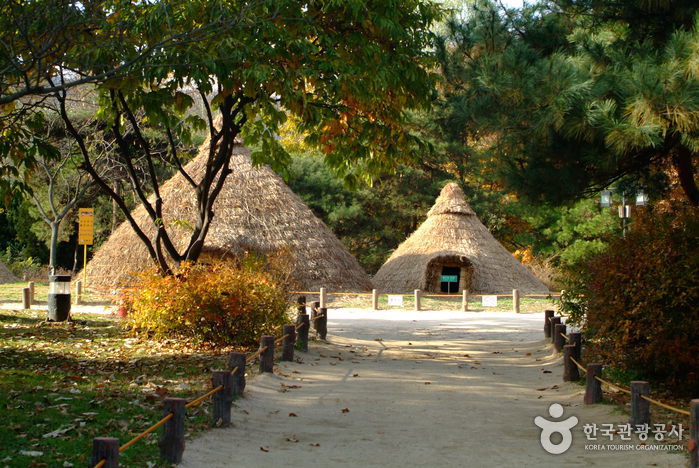
The Archaeological Site in Amsa-dong reproduces the lifestyle of the Neolithic Era. Even the entrance gate is shaped like a huge dolmen and the trash cans are ancient diagonal-line patterned earthenware. Archaeological Site in Amsa-dong was excavated in 1925 when a flood washed away the soil on the banks of the Hangang River and exposed a large number of diagonal-line patterned earthenware. After several excavations, the Archaeological Site in Amsa-dong was established.
The site was a location for a massive colony, thus many ancient buildings, stone axes and stone arrows have been uncovered as well as countless diagonal-line patterned earthenware. The housing site is round with a spot in the center for fire. The site is colossal and possesses nine mud huts, two exhibition halls displaying ancient artifacts and an open mud hut where visitors can experience life in the Neolithic Era. The site offers many attractions such as mud huts and promenades. Archaeological Site in Amsa-dong is also very educational for children and families who want to learn and experience the Neolithic Age.
![Ave Sports - Dapsimni Branch [Tax Refund Shop] (아베스포츠 답십리)](http://tong.visitkorea.or.kr/cms/resource/11/2889011_image2_1.jpg)
Ave Sports - Dapsimni Branch [Tax Refund Shop] (아베스포츠 답십리)
10.8Km 2024-04-23
209, Dapsimni-ro, Dongdaemun-gu, Seoul
-
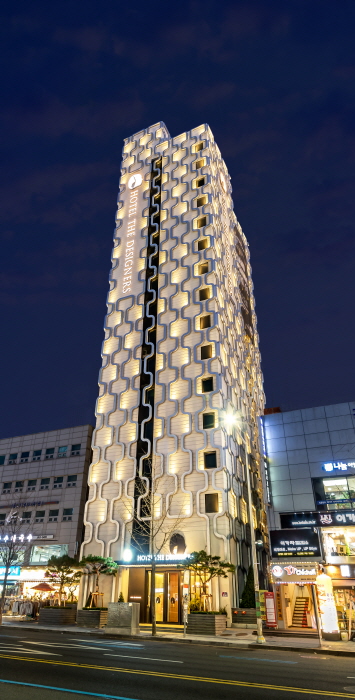
Hotel The Designers - Cheongnyangni Branch (호텔 더 디자이너스 청량리)
10.9Km 2023-05-02
226, Wangsan-ro, Dongdaemun-gu, Seoul
+82-2-957-3300
Hotel The Designers, Cheongnyangni Branch is located four minutes from Cheongnyangni Station Exits 1 and 4 and two minutes by foot from Lotte Department Store. Visitors can take the KTX at Cheongnyangni Station to Gangneung and Yangpyeong or the ITX-Chungchun to Gapyeong, Nami Island in Chuncheon, and Yangpyeong Sheep Farm. Dongdaemun Market is only seven minutes away on Seoul Subway Line 1 and Incheon International Airport can be reached in one hour by car. The front desk is open 24 hours and free Wi-Fi is available throughout the accommodation. Parking is free and there are also valet services provided. Smoking is prohibited indoors. Each room is equipped with LED cable TV, refrigerators, free water, and an electric kettle. The bathrooms have bathtubs, shower facilities, and a bidet.
 English
 한국어
한국어 日本語
日本語 中文(简体)
 Deutsch
 Français
 Español
 Русский


